

What to expect on your first visit
Medical Assessment & History
When a patient arrives at the clinic for the first time, after a break of some time, with a new set of symptoms or when circumstances dictate it would be prudent for a full assessment to be carried out, a full medical history will be taken, or reviewed, depending on the circumstances. This is a verbal dialogue between the practitioner and the patient and is aimed at finding out if there are any underlying ailments that might contribute to the patient’s problem, or if there are any contraindications to the prospective treatment.
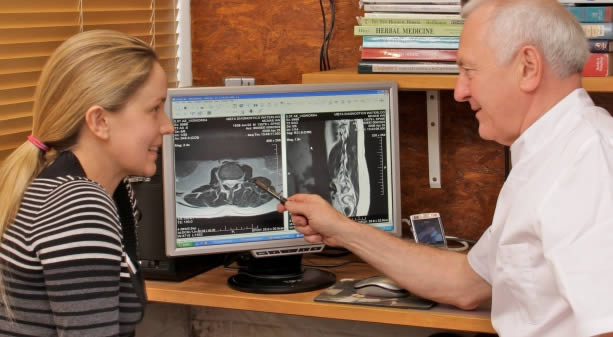
At this time the patient is given the opportunity to present any other pertinent information such as, discussions or letters from their GP or consultant, any radiographic details: MRI scans, x-rays, etc, or radiologists reports. It is also useful to include any previous treatment and the effect, or otherwise, this may have had on the problem.
The Musculoskeletal Therapist will be observing the patient from the moment they first present enabling an initial understanding of the patients symptoms; how they stand, walk, sit and their general demeanour: that is, are there any pains with any of their movements, do they look healthy or unwell, do they interact with the musculoskeletal therapist which may give an indication of emotional or psychological stability.
Posture & Joint Movement Checks
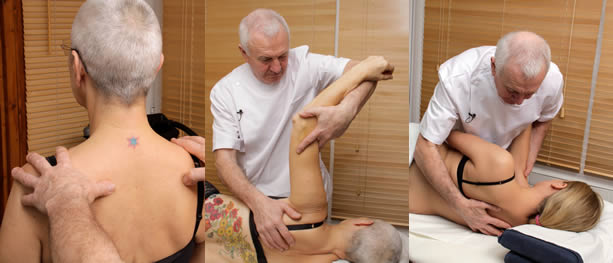
Depending on the patient’s symptoms and presentation further assessments may be performed. These will probably include a number of physical checks; posture, weight-bearing and non-weight-bearing movements, joint movements, pain onset assessments, passive joint movements where the musculoskeletal therapist moves the joints while the patient’s muscles are relaxed, helping to assess which structures are involved in the patient’s symptoms.
Again, depending upon the Musculoskeletal Therapist’s initial assessment and the presenting symptoms, deep tendon reflexes may be assessed to check if nerve pathways are compromised.
Ear, Eye & Blood Pressure Checks
Musculoskeletal Therapists are trained to assess basic medical health conditions and if the symptoms presented by the patient warrant further examination then these may form part of the initial consultation. For example, if the patient complains of dizziness, vertigo, earache, neck or head pain then the Musculoskeletal Therapist may choose to use an instrument to look into the patient’s ears. Other tests to assess the balance and nerve functionality may also be carried out.
Sometimes, from the patient’s medical history, the presenting symptoms or from the Musculoskeletal Therapist’s assessment, the Musculoskeletal Therapist may decide there is reason to record the patient’s heart functionality. This might be carried out with a stethoscope and a blood pressure cuff or, more likely nowadays, a clinically calibrated blood pressure monitor which will give the upper and lower blood pressure readings and the patient’s pulse rate at the time of testing. The Musculoskeletal Therapist may also listen to the patient’s heart and lung sounds if there is reason to do so.
Once again, depending upon the patient’s medical history and symptoms, the Musculoskeletal Therapist may use the ophthalmoscope to check the condition of the patient’s eyes. A simple test with a light source can check the pupillary reactions but, if it is felt necessary, the ophthalmoscope will give a more detailed understanding of the condition of the patient’s eyes.
GP Referral
While an Musculoskeletal Therapist is capable of an initial assessment of the patient’s health and to screen the patient to ensure they are not suffering from any ailment that might prevent further treatment, the patient will be referred to their GP, or the patient advised to see their GP, if any anomalies are detected as a result of the testing.
When the Musculoskeletal Therapist has completed the assessment in the initial consultation and has achieved a diagnosis, that is treatable with MSK Therapy, appropriate treatment may follow.